Ethereum is readying itself to move to Ethereum 2.0. Ethereum 2.0 will shift the consensus protocol from Proof of Work (PoW) to Proof of Stake (PoS). Ethereum 2.0 offers participants that stake their ETH in ETH2 a staking yield. That being said there are some hurdles for staking in ETH2.
32ETH Minimum – The minimum to individually stake would require 32 ETH. Even with 32ETH most ETH holders will not opt to stake individually. The problem with individually staking is that the validator needs hardware in order to earn yield. The easier way to capture staking yields is to lend into a pool, similar to how current PoW miners mine as part of pool.
No Withdrawals – Currently, if an ETH holder decides to stake ETH in ETH2 they are unable to withdraw of transfer their ETH. This is a major hurdle for ETH holders; liquidity is existential to any investment. Withdrawals for ETH2 will not be available until the beacon chain is fully merged with ETH1. This is expected to take at least 12 months. Even once the chain is fully merged, there is a planned 27 hour unstaking buffer period. The lockup is the biggest driving factor for ETH whales not to stake in ETH2 directly.
Hardware Requirements – The move to PoS does not exempt validators from running hardware. Popular ETH2 plug-and-run options are not chap. Not only do you need 32ETH but you need to spend at least $500 + electricity costs. Dapp node seems to be the most popular solution for individual stakers looking for hardware.
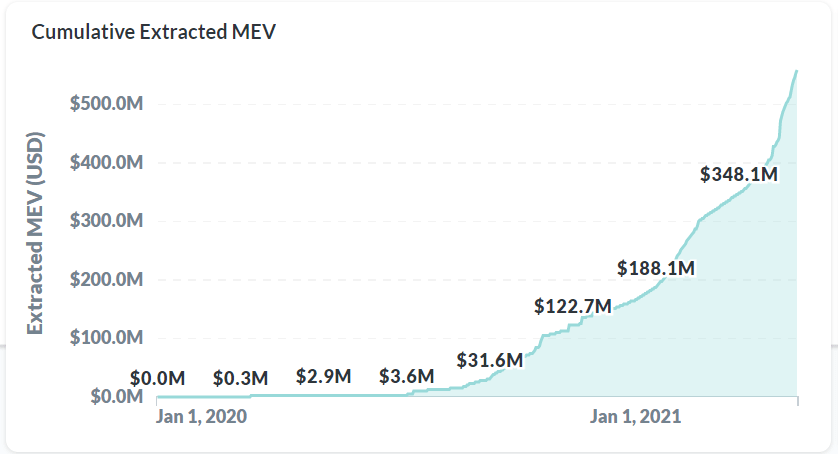
Miner Extractable Value to Validator Extractable Value(MEV to VEV) – ETH became victim to MEV extraction. There were different GETH implementations like Flashbots and KeeperDao to help democratize the mining landscape. MEV will continually happen on ETH2 in the form of validator extractable value (VEV). Due to the chain not being merged yet, ETH2 stakers are paid out via only inflation rewards. Once ETH2 is fully merged, the validators will earn inflation + transaction fees + MEV. If there is anything that we have learned from MEV, that the larger miners have more resources to find and extract MEV. As stated, Flashbots which has been the popular MEV-GETH patch, is currently not compatible with ETH2. MEV extraction by pools will dictate the APY returned to their stakers, this will drive centralization to validator pools.
ETH 2.0 Validator Queue – Not only do validators need 32 ETH and hardware to stake, there is currently a queue in order to activate a ETH2 validator. The activation queue is currently about 8 days and hit a high of 3 weeks at one point. The queue is expected to grow as we get closer to the merge. The wait to get the validator activated is an opportunity cost for pools returning yield to their stakers.
Although these inherent problems ward off people from staking directly into the Ethereum protocol, I do believe these problems are being addressed through different liquid staking derivative offerings. More color to come.
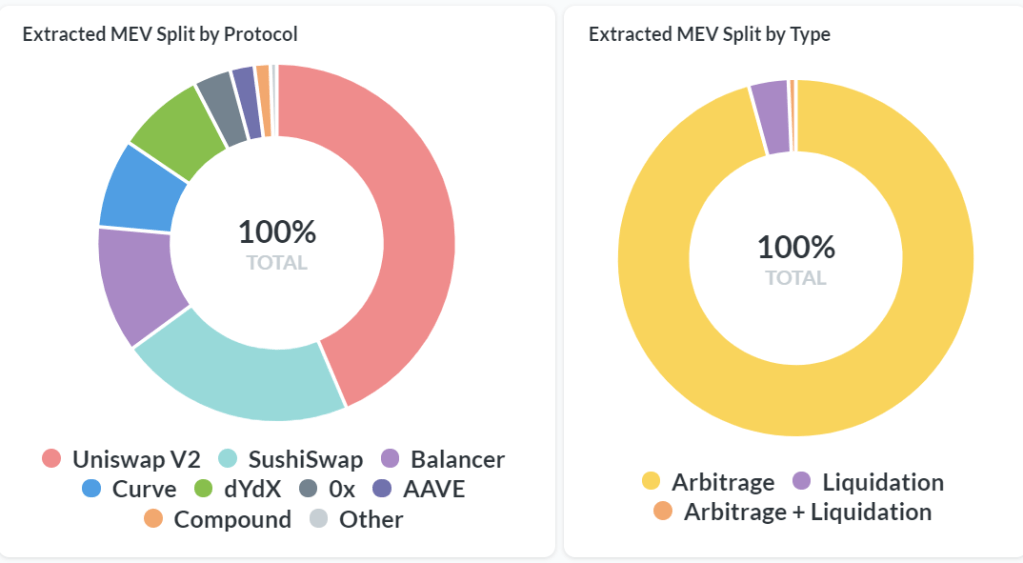
Miner Extractable Value (MEV) is value that miners/validators make by censoring users, reordering transactions, or implementing their transactions before others. Miners are not the only ones searching for MEV. MEV bots, run by traders bid up gas fees in an attempt to prioritize there transaction to extract value. 97% of the time MEV is an arbitrage opportunity. The arbitrage arises from an asset that is mispriced between two decentralized exchanges (DEX). During periods of high volatility, miners can take advantage of liquidations of collateralized loans that fail to meet Loan-to-Value requirements. Algorithmic protocols require liquidity during volatile phases and will sell at prices that differ from the spot price.
The value is extracted by miners probing transactions in the mempool. The miner reorders transactions or inserts their transaction while refusing to include the creator’s transaction. This threatens the security and decentralization of blockchains because it destroys the neutrality of transactions. Miners not engaging in first-price auctions will inhibit all smart contract decentralized platforms moving forward. On Ethereum, these auctions are referred to as Private Gas Auctions (PGA). Miners simply reorder transactions to extract MEV. On the other hand, trading bots race to extract the MEV, which turns into a gas bidding war. The PGA’s begin to rise not only for the bots bidding against each other, but anyone trying to submit a transaction on-chain. This can be harmful to all users, especially those not trying to submit priority transactions. The bidding wars make everyone on-chain pay higher gas fees. It also fills the mempool with repeated/invalid transactions.
Why is MEV happening?
Traditionally, Proof of Work (PoW) chains are First-Price auctions. This implies that miners will select transactions to include in their block based on which transactions have the highest associated transaction fee. This worked seamlessly on bitcoin because the transactions were fungible. Each transaction requires approximately the same amount of computation. A simple wallet-to-wallet transfer represents each bitcoin transaction. This leads miners to the First-Price ordering of transactions. They choose the transactions with the highest transaction fee. Below is a depiction of how to think of the bitcoin state of chain.
via Charlie Noyes (@_charlienoyes) Cosmos presentation
Although, smart contracts on blockchains introduce dimensionality to transactions. Ethereum transactions are have memory, or associated code included in the smart contracts. Unlike Bitcoin, Ethereum has a token along with the smart contract functionality. Transactions on Ethereum are all unique, which creates opportunities to exploit alpha (i.e. MEV). Below is a depiction of Ethereum’s state of chain.
via Charlie Noyes (@) Cosmos presentation
Ethereum consists of two types of transactions:
Inclusion Transactions– Transactions that are simple transfers. These transactions would include transfers of NFT’s or simply sending ETH address to address. Inclusion transactions are not subject to timing. The transaction is unique in that manner, and can not be exploited. Inclusion transactions offer little to no MEV.
Priority Transactions – These transactions are time-sensitive. Prices of currencies are constantly changing, which means to hit limit/spot price, the transaction must be put through ASAP. Priority transactions are usually DEX exchanges. Each DEX list thousands of currencies and multiple DEX’s exist. The open-source nature of crypto allows anyone to fork a DEX or a new currency at the click of the button. Sushiswap, a popular open-source DEX, is a fork of Uniswap. Coincidentally, the two most common places for MEV to be found. Thousands of exchanges can be created, unlike traditional finance exchanges. This leads to information silos across DEX’s and more arbitrage opportunities to be exploited. MEV is most commonly found on DEX exchanges, which are characterized as priority transactions.
MEV extraction is hurting priority transaction creators while also increasing the price of inclusion transactions. Transferring NFT’s or ETH from one wallet to another is becoming more expensive than it should because of miners reordering transactions and bots bidding higher to extract MEV.
MEV Outlook
MEV is impossible to fix. MEV is everywhere because people prefer different outcomes on-chain. Each contract can create hidden value. As long as dimensionality exists on smart contract blockchains, there is no way to completely get rid of it. Therefore, it is a never-ending dark forest of MEV (a term coined by @danrobinson & @gakonst). Neither will we know how much MEV exists nor can we build a bot to extract it all.
Deeply rooted within the MEV discussions are whether it is fair for it to happen. Larger pools are running away with MEV because they have the resources to find and build algorithms to extract MEV. If miners are all attacking each other for MEV, the profitability for most miners drops off drastically. The misbalances create a superlinear function of value distribution across hash power being provided by miners. This in turn erodes the long-term value and security of smart contract platforms. In other words, MEV is driving direct upwards centralization pressure. That being said, the process of MEV brings robustness to the chain. Anyone can arbitrage transactions and in theory, makes the landscape of pricing more efficient.
What’s the move? Flashbots.
Flasbots is an open-source initiative that helps miners capture low-hanging MEV. The initiative decreases miner centralization and attempts to bring value back proportionally to the hash power provided by the miners to pools. Traditionally on PoW chains, miners that are providing hash power to a mining pool are paid out proportionally when a block is mined by the pool. For example, if you are staking 1% of the hash power in a pool, and the pool wins a block, you are paid out 1% of the earnings.
Instead of listing all the transactions in a PGA format (highest gas transactions first), Flashbots acts as a pass-through relayer connecting searchers to miners. Miners are shown bundles of transactions with the highest block subsidy + MEV rather than being shown transactions with the highest fees (PGA style). Miners are incentivized to opt into Flashbots because it increases the amount earned from mining. 80% of miners and about 58% of the hashpower have opted into Flashbots.
Discord members are posting MEV opportunities in the Flashbots channel to stop gas bidding wars before they begin. In the long run, the ETH community and miners are being incentivized to build a more open and usable smart contract platform for users.
This is guy is a legend – broadcasting alpha leaks to keep gas wars off the mempool pic.twitter.com/rnFG9nqaYx
VEV proposes the same essential questions as MEV. Although, as more people stake their ETH with larger validator pools (ie Coinbase, Binance, etc.), the ability to return better yields will hinge upon the specific validator mining pool’s ability to extract value. Presumably, the same effects of which miner centralization that is happening with MEV, will be mirrored in the PoS environment of ETH2. Validators that are extracting the most value will return the best yields, therefore incentivizing ETH holders to stake with them. This causes the same upwards centralization pressure that MEV creates. Flashbots currently works on ETH1 but does not apply to ETH2. This HackMD post from @Izzy- summarizes it best:
The current system will likely lead to a “race to the top” for staking pools, where it will make very little economic sense for most staking participants, and especially “retail stakers” (i.e. purchasers of staking derivatives), to participate in any pool apart from the largest few, which will be able to leverage economies of scale to offer substantial returns while keeping costs low
The ETH2 proposal does plan on having a validator threshold, meaning you can only stake anywhere from 15-30% of the entire network. This of course is to prevent centralization from one pool. Yes, I do believe major staking pools on ETH2 will beat out individual validators which does seem threatening to the decentralization of the ecosystem. That being said, decentralized staking pools are more intriguing than centralized ones. Validators are essentially racing to accrue the most ETH to run the most validators. Decentralized validator pools like Lido and Stakehound may even have advantages due to the ability to offer staking derivatives.
Conclusion
MEV is one of the most interesting dynamics. On one hand, miners doing exactly what they are incentivized to do, extract value while making pricing more efficient. On the other hand, this is creating negative externalities for users of Ethereum. MEV being tackled on ETH is further proof the Ethereum is by far and ahead away from every other smart contract platform. The discourse on MEV is incredibly healthy and positive even as we move to PoS. MEV is unavoidable but initiatives like Flashbots, EIP-1559, and L2 scaling like Optimism all bring hope to make extraction fairer.
The ultimate resource of this world is time. The time you spend on this earth is limited. The average life expectancy is 78 years. By the age of 22, we are thrown to corporate where we sell our time from 9am-5pm everyday. The average citizen works and saves every penny in the hopes to be financially independent. We work hard, spend time away from those we love, pay taxes, yet the government steals the value of our time through inflation. Each hour you spend working becomes worth less in the future. Your time is being stolen by the government . By preserving your time in bitcoin, you can store it generation over generation with provably no deterioration.
The Persistence of Memory by Salvatore Dali
Units in Hours
The average American spends 40 hours a week working. You do this, your parents do this, your grandparents did this. As humans in a capitalistic world we exchange our labor for money, an asset that carries universal perceived value. We can trade the money for goods and services within the economy. Let’s assume you work at a rate of $50/hour. Suppose you decide to take a girl out on a fancy date, you spend $150. You have effectively traded 3 hours of your labor. Every purchase can be seen as a denomination of your time. Groceries cost 2 hours, rent costs 30 hours, gas costs 1 hour etc. you get my drift.
In reality, we haven’t shifted far from the barter system. All we have done is added a medium exchange to transfer value more effectively between people. The dollar is a liquid asset that we use to exchange value. I give you an hour of my time, you pay me $50 instead of giving me cattle or bar of gold. We are constantly exchanging our time for money. Time is money. Money is Time.
Proportionally, the value you create within the economy at a specific moment should be preserved regardless of the change in inflation. In the event that you and your grandfather are providing a similar service to the economy, why should your grandfather’s hours be worth less than yours based on the year worked?
Time Theft
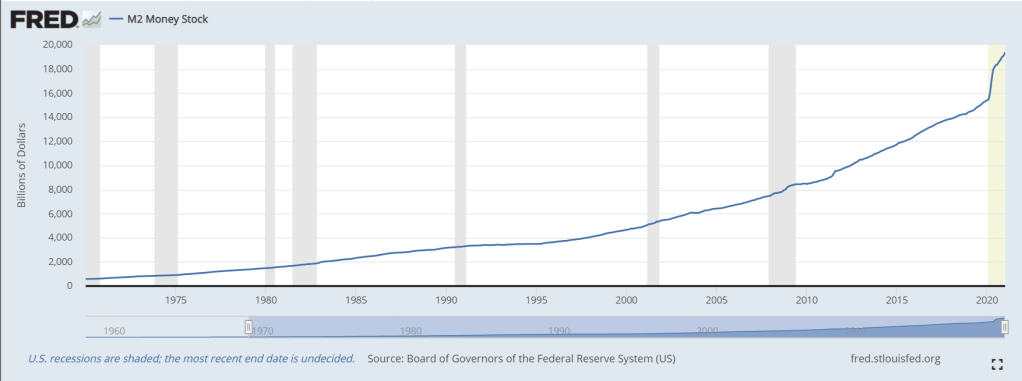
Everything we trade for is denominated in dollars. Assuming the value of goods and services remain relatively unchanged, your raw statistic on inflation should be the money supply. Money is the measuring tool of value. M2 measures the amount of total money in the economy. This includes cash, demand deposits, checks, and money market funds. Since 1970, M2 has seen a 33x increase.
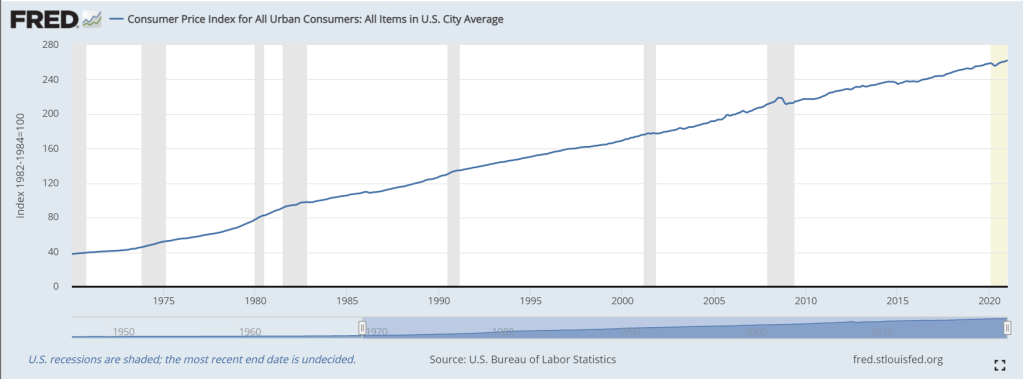
Although, M2 is not used as the inflation metric by the Federal Reserve. Instead, the Federal Reserve uses the Consumer Price Index (CPI). The CPI is comprised of an ever-changing basket of goods that includes items the Fed believes are essential to living. The CPI will include items like rent, food, energy, tv’s, refrigerators, phones etc. As you can see below, the CPI has only 7x since 1970.
The CPI is the go to metric for the Fed, yet there are many essential assets that have outpaced the CPI’s inflation. The basket of goods is not outright defined but rather decided arbitrarily. For this reason, people contest the legitimacy of the CPI. For example, since 1980 the CPI has lagged behind the rising rates of college tuition.
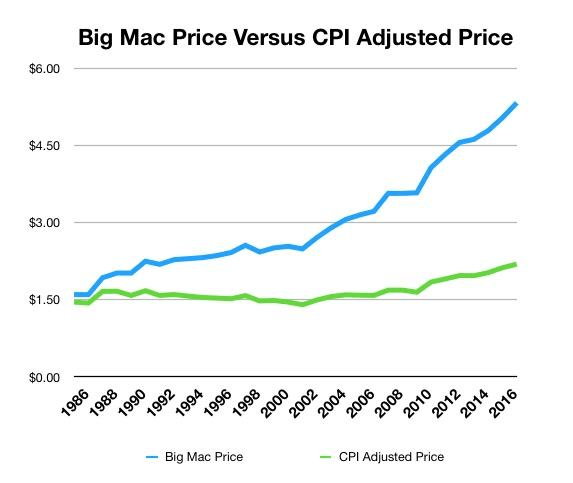
Synonymously, the Big Mac Index which has gained popularity as an informal measure of inflation, has also outpaced the CPI.
Whether or not you believe the CPI is a true inflation metric, a 7x inflation since 1970 is nonetheless concerning. Not only is a 7x concerning, other hard assets are witnessing faster inflation than the CPI.
Taking Your Time Back
Bitcoin is the asset to take your time back. As your friends run on the fiat treadmill for 40 years to save enough money to retire, you can simply store your time in bitcoin. A fixed monetary policy allows holders to plan for future inflation. Currently, bitcoin is dubbed as a “speculative asset”, yet the only thing we are speculating is the monetary policy of the US dollar. I will pass my wealth to my grandkids, unhindered of what the Fed decides to do tomorrow. Why risk exposing myself to USD’s whimsical value swings? The thing I am sure is that there will only be 21 million bitcoin. This will lead bitcoin to be used as a wealth transfer across time
Bitcoins recent run up has led people wondering where they can start their bitcoin journey. This is a collection of resources and the train of thought that guided me through the bitcoin rabbit hole.
The bitcoin journey begins by trying to understand why this imaginary money could be useful. There have been multiple visions debated. Nic Carter (@nic__carter) & Hasufly (@hasufl) explain the different value props bitcoin has commandeered.
It becomes clear that the digital gold narrative has gained the most steam. To test the narrative, bitcoin must be compared gold. Vijay Boyapati’s (@real_vijay) bitcoin bull case is a timeless piece. The essay dissects core characteristics of money and applies them to bitcoin.
Matt Huang (@matthuang) lays out an identical digital gold thesis. He also refutes a few bearish bitcoin arguments (i.e. bitcoin is a bubble) which are incredibly important to internalize. This thesis paper is an absolute must read.
Once the comparison for bitcoin as digital gold is understood unpacking why we need a store of value now more than ever is explained by an all time great macro investor, Paul Tudor Jones.
Why do we need bitcoin if we experience minimal inflation in the US? Outside of my contention with CPI measures, there is a genuine need for stores of value in emerging countries that experience hyperinflation. I explain the emerging market adoption in a previous post. More specifically, this hackernoon article is what solidified the potential use case for crypto in suppressed emerging countries.
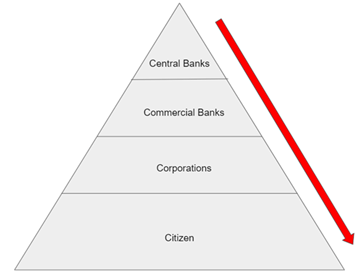
Inflation hurts everyone in the monetary ecosystem, but it especially hurts those in lower social classes. Whoever is issuing the currency sees the highest value of it (i.e. government). For inflation to be realized within an economy there is a trickle-down value effect. Central banks see the highest value of the dollar printed, while the consumer who sees it last, will witness the least value in the currency. It is something I call the Currency Value Deterioration Pyramid. This is also academically called the Cantillon Effect.
Currency Value Deterioration Pyramid
This begs the question of how to launch a fair money? This was a major debate when cryptocurrencies were launching ICO’s (initial coin offerings) similar to IPO’s. Although a bit in depth on altcoins, Hasu and Arjun Balaji (@arjunblj) dive into the fairest way to launch a currency. The TLDR can be summarized by this quote:
the concept of “fairness” is ultimately subjective and a “perfectly fair” launch a pipe dream
Bitcoin is the fairest launched currency, even compared to fiat. Unlike the value deterioration pyramid that citizens suffer from, bitcoin adoption has been led by the people, not central governments.
Bitcoin is becoming the freedom currency. Skeptics will say early adopters are unduly befitting from late buyers. Although buying bitcoin pre-2016 was incredibly risky. People have been working on perfecting a cryptocurrency for decades and still are. Whether bitcoin was going to become the clear winner was not certain. The adoption of bitcoin is flipped from that of a nation-state currency led by early adopters to retail investors to institutions. Maybe the last leg will be led by central banks? The US government is known to be holding the largest reserve of gold.
Outside of adoption cycles, bitcoin has an immaculate social layer that allows everyone running a node to participate in defining network rules. Anybody can vote on changes by simply running a node. On the other hand, citizens have no say for fiat currency changes. We are subject to whatever our policy makers feel is correct, which has become printing money at will. The social contract is an opportunity for bitcoin holders to have their voice heard. It is incredibly important feature of bitcoin.
My concluding thesis: Bitcoin will become the vehicle of seamless global payments, wealth protection, and liberation splintering from current nation-state monetary failures.
We have accelerated faster to a digital transformation than anyone could have guessed. In 20 years we have gone from wired car phones to unbound devices that are wirelessly connecting people trans-continentally. The internet has truly bred into something even ambitious imaginaries couldn’t have dreamed of. The rippling effects of a globally connected is merely beginning. A pseudonymous economy is a workforce that is chosen on proof of work, powered by the proof of work currency, bitcoin.
At an abstract, social media has become the vector of rating peers. In a sense, social media platforms have become a reputation verifier which has spurred the era “influencers”. On Instagram, you build a reputation by the photos and pictures you post, it’s the visual reputation platform. On Twitter, your thoughts or ideas are liked/retweeted, a platform built on words.
Although we get hooked on the negative externalities social media is having on peoples’ personal lives, there is a divergence in content and personal character. To clarify, avatars are being born in the cyberworld that help people escape who they are in the world of atoms. The avatar removes any stereotypes that may be linked to our appearance or character. This is a material shift from the ethos/pathos to logos. A single person can spawn multiple identities online. They can be however foolish, childish, or controversial.
The internet is a catalog, we can upload and download content at our hearts desire. Twitter and Instagram were media platforms envisioned for social uses. Both have fostered different communities that are focused on learning and expanding knowledge that stems past reposting memes. FinTwitter and CrytpoTwitter are two major atypical twitter communities. FinTwitter conversations can range from stock charts, to venture capital theories, to personal finance advice. You can find advice and live thoughts from some of the greatest investor in the world. CryptoTwitter has a deep rooted culture in memes. Some of the most respected figures on CryptoTwitter have avatars of… ducks or random memes. They often meme but do it decisively to make a point. They are having fun while also bringing new perspective. They are building an online personality based on words, not who they are. No institutional blue checks, only words to build a following.
The pseudonymity of CryptoTwitter stems from Bitcoin. Satoshi Nakamoto, the founder of Bitcoin, is a pseudonymous founder. In the invention of a new money, he did not want his credentials or visions to cloud the direction of Bitcoin. Following suit, crypto twitter personalities have embraced the beginning of a pseudonymous internet.
Samczsun epitomizes a pseudonymous worker. An anime character is used as his professional profile. He/she recently joined Paradigm, a prominent crypto-focused firm that has raised money from the likes of top venture investors in Silicon Valley.
@Samczsun Research Partner at Paradigm
Paradigm has raised over $750m. It is led by Fred Ersham, Co-Founder of Coinbase, and former Managing Partner at Sequoia Capital, Matt Huang. Paradigm is littered with Ivy-League talent, take a look for yourself.
Colleges have been the gatekeepers to knowledge. Once a person has received the so called “Ivy-League Stamp” they become a part of this upper echelon of society. This barrier is beginning to be cracked by characters like Samczsun that are based on proof of work. Maybe Samczsun went to an Ivy-League school, no one will know and neither do would they care. Building portfolios on the internet to display work is easier than ever. Publishing public repositories on Github, blogging on Substack, posting artwork on Instagram are all mediums to prove yourself. The Ivy-League badge is being challeneged by communication platforms that were meant for posting pictures with friends on friday nights.
Building a repertoire online hidden behind an avatar is cool, but how are we supposed to transact without giving up personal information? Enter bitcoin. A pseudonymous money powering a pseudonymous economy. Payments should be seamless for gig economy workers and corporations. Fiat transactions require bank accounts that store personal information which makes everyone subject to big brother surveillance. The privacy that bitcoin brings to the digital world, is synonymous to the privacy cash brings to physical transactions which empowers pseudonymous workers like Samczsun.
When bitcoin becomes a topic of discussion, people usually immediately fall on the value prop that it is an alternative to gold. But within the store of value proposition, often is forgotten why gold has become a money. Inflation resistance for emerging market citizens is still an undervalued narrative. Countries like Venezuela and Turkey are prime examples.
There is a rich history of governments banning the possession of gold. FDR did it in an attempt to strengthen the US dollar while he diluted the circulation. Today, Venezuela suffocates stronger currencies from entering its borders. The money printer goes brrrrrr as the country suffers from crippling hyperinflation. Question becomes, how do Venezuelan’s preserve value without access to gold or currency exchanges?
Mining crypto has become increasingly popular. Accessibility is a harped on benefit that crypto has versus physical gold. Gold’s lack of transportability has led to instruments like paper gold. That being said, self custody on gold must be physical which is where digital gold (bitcoin) picks up the slack.
Skeptics question why citizens would hold high volatile crypto assets to store value. The argument of volatility goes mute when comparing it against currencies like the Bolivar. What may seem like overblown news on volatility of the Bolivar, was confirmed from an anecdote I heard from a Venezuelan classmate.
A girl in my class was at the store and liked a pair of shoes. She brought the shoes to the counter, only to realize she left her wallet at home. When she asked the employee whether the shoes could be put on hold until she returns with her wallet. The employee responded, “I’m not sure if I can do that, the price of the shoes may change by then.”
Thousands of underground mining operations are active in Venezuela. The threat of crypto entering Venezuela was seen as an attack on it’s national fiat currency. As expected, the government has been cracking down on these operations. Considering mining diamonds and gold is illegal, miners fear that the government will come for their operations too.
Synonymously, there was a slight uptick in volume on bitcoin exchanges when the Turkish Lira crashed in 2018. In 2020, COVID economic pressures and excess printing of the LIRA has returned. Paxful, a Turkish crypto P2P exchange, saw a 274% increase in new registrations last twelve months. Turkey has been leading the cryptocurrency adoption in the Middle East.
The beauty of crypto is that not only is bitcoin gaining adoption, stablecoins pegged to the dollar should also act as a safe haven for citizens in countries subject to hyperinflation. Crypto adoption globally is in the bottom of the first inning. There is an obvious need for a more accessible store of value in hyper-inflationary environments, but US citizens are still naive to the legitimacy. As stimulus and quantitative easing is realized, I suspect the staunchest of skeptics will be turned.
This post was originally published for Game Theory Crytpo Group in July 2018.
Imagine walking into a Chuck-e-Cheese and having to buy different tokens for every game you wanted to play. This is essentially what crypto has brought to us as far as utility in altcoins go. Each and every single utility token has built a private ecosystem that is closed off from the rest of the world. Interoperability has always been a heavily debated topic, yet more and more utility tokens with absurd valuations keep popping up. Instead of moving closer to a more user friendly environment, interoperability across tokens has decreased. The solution is so blatant that often times we fail to recognize it. The solution is Bitcoin.
After a massive run up in late 2017, it was clear crypto had become the next wealth generator. Unprecedented returns were being seen, and those that were late, refused to enter at astronomical price points seen in December. In order to lure new investors, people propped altcoins with no real use case, purely raised money on speculative utilities. These greed monkeys that saw an opportunity to make real money in a nascent space by building out horizontally. Why build on bitcoin when you can create your own token and sell it as the next big thing? Accredited investors and VC firms backed many of these tokens prior to an ICO (initial Coin Offering), because they were offered discounts in the private sale round. During December 2017 just about any ICO could have raised 10 million. It was an opportunity to dump on retail investors and make 100x returns.
Retail investors saw tokens gaining steam from well-known firms and bought in for long term prospects. The excessive buying from retail post-ICO would build minimal liquidity in an a chronically illiquid asset class. After investor token lockups ended, they would dump on the open market spurring a massive sell-off. These large sell offs would often even come from those who created the tokens.
The process to create a token was as simple as forking an existing token and making minor changes to the code. Founder of Zclassic, Rhett Creighton, was notorious for doing this. Fork, raise money, and dump SZN was in full affect late 2017/early 2018. We ended up with shitcoins piling into the market that were simply tokens with elaborate marketing schemes through the use of buzzwords.
The key is seeking out low cap tokens with buzzwords that retail investors eat up once the token hits high vol exchanges.
This is what we asked for when we entered an open-software space (outside of Ripples trash closed software). Although I find most tokens in the space to be extremely useless long term, the horizontal growth has allowed to test use cases that might have validity. Everybody is searching for a unique take in a now, crowded space with various competitors. Prediction markets, the ability to access unused computing space, smart contract platforms, several different on-chain governance schemes. The market has expanded out to testing just about everything. This is the definition of a free market even though it was created through greed by most token fouders.
Why build on top of another token when you can create your own? Why not build up a massive reserve with multiple rounds of private funding with no SEC obligations to the tokenholders? Horizontal growth is now. Vertical growth is next. Bitcoin will soon eliminate the need of utility tokens with implementations of different layers. Lightning network is about to unleash “Satoshi’s OG Vision” (@ Bitcoin Cash) of micropayments. The most exciting part is not the fact bitcoin will be used for micro transfers but the world of possibilities bitcoin will be opened through a potential third layer. Lagged by slow throughput bitcoin will now be able to support to support larger applications on the third layer. Utility tokens will soon be rendered useless through better bitcoin dApps and eventually privacy will be built on bitcoin too.
This vertical growth has been forgotten thanks to the wealth alt tokens have created. In reality, we must create a better user experience that doesn’t require switching currencies when hopping from one whack a mole machine to the next. Vertical layer growth is next. No more shitcoinery please.
Coronavirus has accelerated the cybereconomy faster than we expected. WFH has turned to Work from Anywhere (WFA). Millions of people who have been grounded to a specific city for decades are now dispersing. Cloud stocks and virtual workspaces like Microsoft Teams, JIRA, MuleSoft are the backbone of the WFA movement. The pandemic propelled us into a contactless economy that was inevitably headed our way. The next generation of the economy will be built in the cyber realm. Prior to cloud deployment of applications, building an online presence was a tall endeavor. It required servers on premise and high infrastructure costs. The cybereconomy unlocked a cyber workforce. With a globalized cyber workforce, there are inevitable taxation problems countries will encounter.
Software workflow streams have moved from waterfall to agile, allowing Product Owners to split stories into individual tasks. The granularity that is being enabled is furthering micro tasks to be contracted to gig economy workers. There are multi billion dollar companies being built remotely. The lack of a physical HQ allows companies like Binance to access talent from anywhere in the world. Crypto companies are not the first to take advantage of global gig economy workers, and certainly will not be the last.
Software focused companies are harnessing the power of WFA. Immigration restrictions Trump recently placed forced big tech to move teams north of the border. Coronavirus limited contact Google, Twitter, and Facebook have announced WFA until summer of 2021. Many companies are following the lead and offering remote first as a employee perk. Pinterest recently cancelled their lease in downtown SF. The company paid a reportedly 90m to cancel the lease.
Wow.
“Pinterest terminated its massive 490,000-square-foot lease, …citing a shift towards more remote work amid the coronavirus pandemic. The company will… pay a one-time fee of $89.5 million to cancel the Bluxome lease.” https://t.co/ks04ToNmDA
Pinterest may not be the size of FAANG, but what is stopping the FAANG companies from moving HQ to another country if talent is captured remotely? Remote-first work and internet contractors are an emerging threat to the US ability to keep major tech companies within its borders. Tech HQ’s will not immediately cease to exist. There’s an obvious reason so many tech companies have stayed in California; SV has a lock on high end developers. Whether coronavirus encourages other cities to create better software dev culture is yet to be seen. Although, FAANG moving to a WFA will certainly encourage software devs to explore other cities. Austin has become a popular destination for SV geeks.
Freelance work is becoming incredibly popular on sites like Fiverr. Enabling sellers to provide services in a free market is driving down the costs of simple tasks like setting up your AWS. Marketplaces that allow developers to build reputations are inevitable. The beautiful part is that workers can even pseudonymously build reputations, as Balaji Srinivasan has outlined.
The implications of increasingly remote companies are perplexing and undefined. Company structure like Binance’s is purposely done to have a lower tax obligation. More enterprises will follow on the face that smaller nation-state’s provide tax incentives. Moving to tax havens is already an existing trend. Walmart is purposely headquartered in Delaware to minimize tax obligation. The Cayman Islands are the fifth biggest financial center in the world in large part to the absence of corporate taxes. Ultimately, the US is simply another nation state bidding to keep it’s customers which makes taxation a tricky matter.
Why do casinos had out millions of dollars of free plays and room service to their largest clients? It’s promote casino loyalty. Similarly the US government needs to incentivize companies to stay. This already happens at the state level to lure companies into their regions. Amazon’s infamous 2nd HQ fallout in NYC shows why taxing corporations is a difficult endeavor. We yell ‘TAX THE CORPORATIONS! TAX THE WEALTHY!”, but within that narrative jobs and imperative tax dollars are lost. In reality the government has it’s hands tied behind it’s back and it is on it’s way to getting much worse. They can try to tax and regulate mega-cap corporations, but digital economies of scale will lead to a mass exodus of tax generating corporations if the US does not proceed carefully.
Not only is the digital economy threatening the US’s ability to tax its top corporations, but it’s stranglehold on the USD being the reserve currency is a looming threat. There are three steps to the cyber realm according to The Soverign Individual. The first was the digitization of information, making the internet a catalog. What once took hours of encyclopedia digging, was made easy through Google search and online forums like Wikipedia. The second progression is the coming of cybercommerce. Within this step, e-commerce companies submit to the jurisdiction of their respective nation states as the internet gains it’s footing. This is currently where we are. E-commerce companies are restricted to US legislation. As gigabytes of data are moved at the speed of light and more internet economies prop up globally, we will transcend into the third progression. This will be the turn of the free, decentralized, cybereconomy. Emergence of third-party free cyberbanks, cyberbrokerages, and cybermonies will be trusted worldwide. In this third progression, nation-sates will lose control in their ability to force citizens to use state issued fiat (i.e. Venezuela).
The internet is globalizing faster than ever. The cyber gig economy has been thrust 10 years into the future thanks to a pandemic. Although a transition to a cyber economy and cyber money seems like a sharp, unrealistic departure from the current state, the pressures it has on nation-state’s ability to juristic corporations are understated. Welcome to a global economy powered by a global money. Hello Bitcoin!
The average day in a consumer society has vastly changed throughout a single score. Take your average Joe for example. In 1999, he begins his day by going to get his daily coffee. After ordering his caramel macchiato and everything bagel toasted, he waits 10 minutes in the drive-through line. Upon arriving to the window, he pays in cash and leaves the remaining change in his center console full of miscellaneous objects that haven’t seen the light of day in years. Fast forward to 2019, Joe’s day begins with the same caramel macchiato and everything bagel toasted. However, this time he orders prior to leaving his house on his iPhone. Upon reaching his local coffee shop, his coffee and bagel are on the ready-to-go counter.
Consumption of goods is becoming seamless. Within 20 years, consumption of commodities has completely transformed. Music lovers have gone from buying albums in stores to instantly downloading albums on Spotify seconds after the release. Sneakerheads have transitioned from waiting days in line for sneakers, to buying the latest trends in one-click on the Nike SNKRS app. Apple pay allows Joe to pay for his groceries without carrying his wallet full of cards, cash, and change. Venmo, a PayPal company, lets Joe buy cannabis from his local dealer or order uber eats from the finest restaurants in the district.
This transition stems from the ease of online payments. PayPal, fabricated during the .com bubble, and has ever since excelled in simplifying sending money online. They became the payment rail for Ebay, a website that empowered people to sell items they no longer needed. This was a massive transformation ideologically for humans. It proved an alternate economy could exist on the worldwide web. Today, billions of business transactions are paperless. The cost, efficiency, standardization, and speed are powering digital money. Our intrinsic appraisal of money becomes convoluted due to the velocity of transactions. Where money has been and where it is headed requires a deep dive into the origins of money.
The necessity of money begins with trading goods and services. In economies of scale, producers of goods are more profitable when they consistently produce the same goods. This is simply a function of time. Joe cannot produce the greatest quality wool in the community if he spends all his time hunting for meat. Communities were built through specialization by its members. Sprouted from this was the barter economy. A barebones economy that consists of a hunter trading for sheep, or the herder trading for meat. Although this economy seems straightforward, it remained largely inefficient when the hunter wanted to trade his meat for shoes, but the cobbler had no need for meat. The barter economy direly needed an intermediary good to facilitate trade between vendors, especially with those that produced time sensitive goods. The race to find a medium of exchange begun.
Each economic transaction has two parties engaging. Each party provides some marketable value to the other. A party is either trading for direct or indirect consumption. The party trading for indirect consumption is looking for higher marketable value for future transactions (Ludwig Von Mises, 1912). Commodities of higher ‘money-ness’ have battled over the years, and this phenomena continually progresses.
Each money that has risen, inputs additional empirical evidence to what characteristics of money homo sapiens are in constant in search for. Vijay Boyapati’s framework serves as a good schematic approach to why previous monies were left behind. ‘Money-ness’ characteristics that generate more marketable value for a commodity are determined by durability, fungibility, verifiability, divisibility, scarcity, adoption history, and censorship resistance (Boyapati, 2017). It is these characteristics to which we can explain Simmel’s proposed theory of money being a concentrated value of exchangeability. Simmel states, “Only money, in terms of its pure concept, has attained this final stage; it is nothing but the pure form of exchangeability” (Georg Simmel, 1900). Money is simply a concept with a schema of characteristics us monkeys have decided to be most important. It brings finality to our transactions making it more desirable. Societies have produced various different ways to exchange value prior to universal fiat money. The proceedings of paper money trading should provide evidence to what a world without paper money may be.
Chapter 1: Commodity Money
One of the most unique monies incepted were rai stones. On the island of Yap, located in Micronesia, the villagers used the massive, unmovable, quartz like rai stonesas money. The colossal rai stones were set in one place after being imported. The villagers would keep a public ledger of who owned the rai stones. The distributed ledger was kept by numerous citizens to prevent mistakes or fraud. Possession of the rai stones was highly valuable. The stones became entrenched as a part of status. Few stones of these beautiful stones were available yet they were wanted by all. The stones became a part of the island’s culture and religion. Rai stones became a popular means of payment for dowries. Additionally, they were accepted as a form of tax payment. Metals like silver and gold were unknown to the Yap and the rai stones served a very important duty of money for the micro-society. As time passed, the process of importing rai stones became easier for the Europeans. This soon became another market opportunity. Rai stones flooded onto the island by the Europeans and the value of the rai stones depreciated. The coming of a commodity such as stones on a distributed ledger. The scarcity of rai stones were imperative to its value. When more stock hit the market, the status symbol of owning rai stones was no longer so elite. The Yap stones show us how an isolated environment can lead to people valuing something as absurd as rai stones.
Around 6000 BC there was an emergence of another money. This time it was shells. Shells became a prominent form of money for those living in America, Africa, and Asia. Being isolated from the western hemisphere until the 15th century, the Native American tribes of America had a different shells of choice to use for money. Wampum shells gained popularity east coast of America, while Dentalia shells were primarily used on the west coast. The rest of the world, trended towards using Cowrie shells. The shells were not only more portable that rai stones, but they were worn as jewelry. Every shell had unique traits that would be shown off by polishing the shell. Shell necklaces became largely popular amongst the Native Americans. The shells were easy to transport and proved durability over time.
Outside of jewelry, shells served many purposes. In a similar fashion to rai stones, the wampum and dentalia shells became a part of tribe culture in America. Shells were buried in graves and were offered in rituals. In India, cowries were placed next to religious idols and also used in a board game called Pachisi. In China they represented status and wealth. Multiple members of the Shang dynasty were buried with thousands of cowries (Yang 2011). Shells had rooted itself in multiple cultures which led to a wide acceptance that stimulated a global economy. They became means of payment for ransoms, fines, taxes, spices, and various other economies including the slave trade. Cowrie’s which originated from the Indian Ocean was soon spread all throughout Africa. Shells later fueled the Atlantic slave trade run by the European nations. Tribes in Africa fell in love with the beauty of the shells. Rival tribes would kidnap people from opposing tribes and sell them off to the Europeans for shells.
There were pitfalls that came when using shells to trade outside of the iniquitous economy that it fueled. Not all shells were the same size, shape, or color. There were a handful of differentiating factors shell to shell, which meant the shells were not fungible. Fungibility is important when attempting to price items within the economy. Each person has particular preferences to the details of their shells creating an ambiguous value for each shell. A pound of potatoes could be worth 3 or 30 shells dependent on the seller’s preference. The uncertain value of shells between markets urged buyers and sellers to find a new money.
Shells disappeared and in came the metal money age. Silver and gold accumulated from colonization of Africa and Asia to Americas in the 15th century. The consistency of the metals almost instantly replaced the shells. Gold and silver were consistent, durable, fungible, and scarce. In addition, the malleability of the metals became the defining factor that triggered the metal money age.
Nuggets of metal were fueling a global economy and governments were quick to become the trusted central party. The Roman Empire was one of the first dynasty’s to issue its own currency. They began by minting bronze coins. This lasted for approximately a hundred years until silver coins became the new contender to bronze. Bronze, a copper alloy, became devalued against silver. Copper was simply mined at a faster rate than silver. In turn, bronze coins entered the market faster than silver resulting in the market switching to the scarcer money. Silver continued to gain value against copper which made it practical to exclusively hold silver. The transition from copper coins to silver was a major event. It showed that the population converged on a singular exchange of value.
Analagous to how silver replaced the need for copper, gold eventually overtook silver as the primary money. This was and will be the final step in metal money. Gold trumped silver for the same reasons silver hopscotched copper. Adam Smith in the Wealth of Nations states, “Silver would appear to measure the value of gold, and gold would not appear to measure the value of silver”(Adam Smith, 1776). Silver overtime was losing the scarcity race to gold. The continued scarcity skid against gold would prove to be everlasting. The future value of silver always returns a negative net present value in comparison to gold. This juxtaposition holds true for all commodities stacked up against gold when evaluating preservation of value. Gold progressed through being a medium of exchange and evolved into a store of value.
Gold was proved to be malleable, durable, and scarcer than anything else homo sapiens had found. Metal money is also censorship resistance. Although the Roman Empire minted gold coins, they acted as the central party verifying the weight of the coin. Global acceptance of gold provides liquidity when spending across borders. No government can single-handedly devalue your gold. It is a truly decentralized money that can be mined by anyone. There is no central point of failure and everyone has a fair chance of retrieving gold. Gold mining is a painstaking process that requires labor and time regardless of government or innovation. The fixed, estimated stock of gold gives no one the power to drastically change its value (Ludwig von Mises, 1912). These characteristics throned gold as the winner of fixed money and at a time the chosen medium of exchange for societies and cultures across the world. Overtime gold became entrenched in cultures and rituals. Demand increase with no drastic change in the supply schedule has led to gold slow but steady growth against the dollar.
It is the hunter gatherer within us that wants to collect and store the most valuable, hardest to get commodities. Humans hoard gold because of the broader economic marketability. Money is a free market. The market participants, being the people, converge on the best money, that being gold.
Your relentless pursuit of perfection was unparalleled to anything I had ever witnessed growing up. You left me heartbroken in 2009 and I hated you for it. I tried to find faults in your game and character, but the deeper I dug, the more I respected you. The tenacity you brought to the court was a testament to your work ethic. All-star game or game 7 of the NBA finals, you gave every basketball challenge your 100%. You led a generation of players that modeled the “mamba mentality”. Your greatness will never be forgotten, and shall be carried by those that follow.
Being the best on-court is hard enough, but being the ideal citizen off the court is even harder. After one early career slip up, you cleaned your act up and never once did we see another blemish. A loving father to 3 daughters while striving to be the best on the court is no easy feat. The transition from player to coach and father was seamless. Similar to basketball, you perfected fatherhood and became a role model for young NBA fathers.
At first I refused to believe the tragedy. Not Kobe. Not now. It took a day for me to realize the severity of the accident. I tried not to think about it, but the highlights poured in. It made me realize how much of my childhood you represented. You renewed the classic Celtics vs Lakers rivalry, and single handedly carried your team to beat 3 hall of famers. 2009 was the moment I knew you were superhuman. Your body and mind were always in constant harmony, and you gave basketball some of the greatest performances ever.
Thank you for the memories and life lessons you taught us. Rest easy Kobe & Gigi.










 Dhruv's Bubble